
Decentralized finance, or DeFi, has pushed the boundaries of the traditional finance world as it has shattered the limitations of intermediaries. Today, we’ll delve into one of the prime ecosystems leading the DeFi rebellion – Uniswap.
Unveiling Uniswap
Uniswap, introduced in November 2018, broke ground as one of the first decentralized exchanges, aiding a revolution in finance by fostering an open, accessible, and equitable financial landscape. Capitalizing on Ethereum’s powerful smart contracts, Uniswap opens up a broad spectrum of decentralized services, including but not limited to token swapping, liquidity provision and decentralized governance.
The Genius of Uniswap’s Protocol
Uniswap operates via an automated liquidity protocol. In essence, this means it allows users to trade directly from their private wallets without requiring an order book to match buyers and sellers. Instead, smart contracts facilitate the trades, providing near-instant executions and a dramatically simplified trading process.
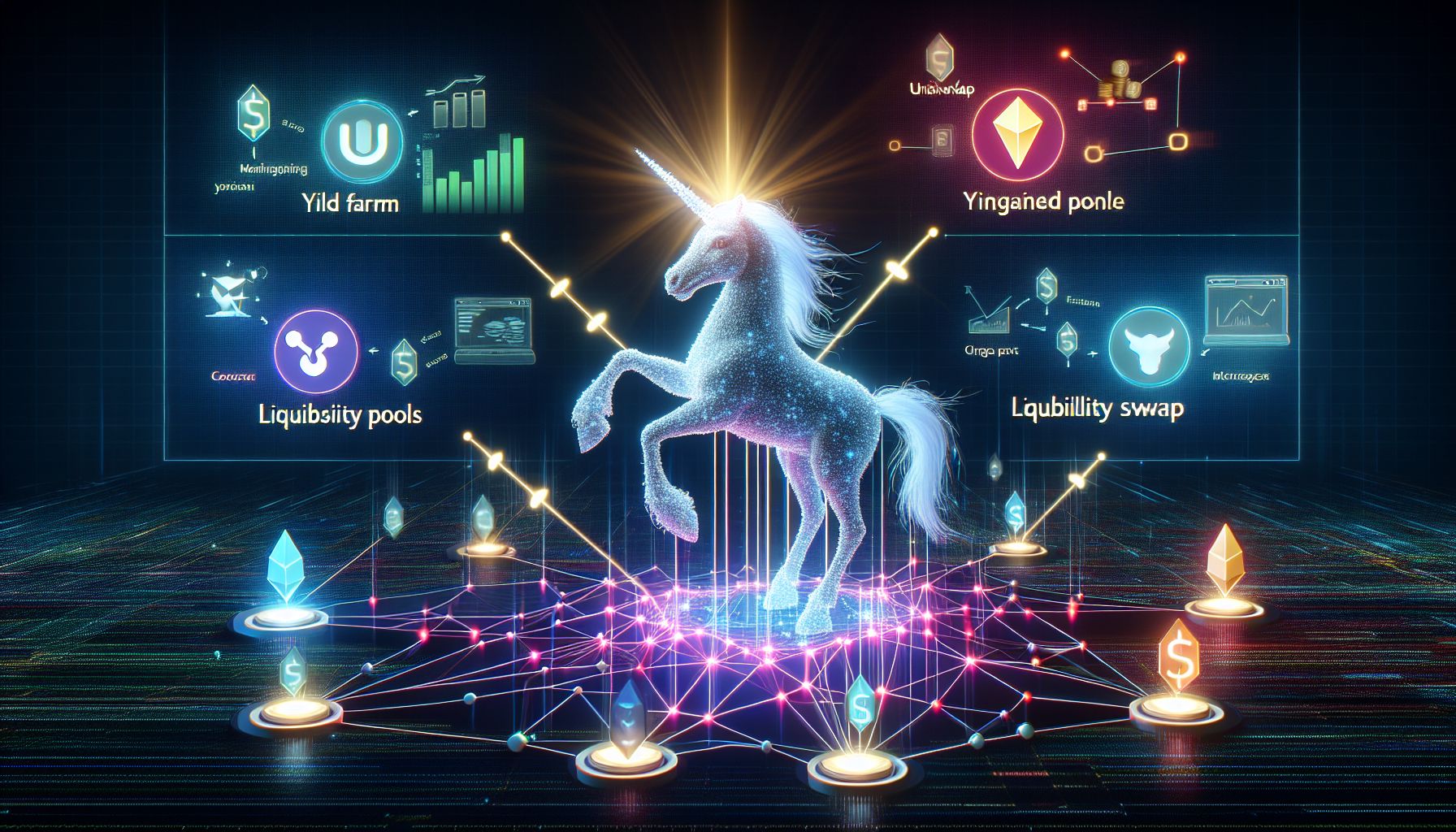
Liquidity pools are fundamental to Uniswap’s operations. Any user can become a liquidity provider by depositing their assets into a smart contract, forming a liquidity pool. When trades occur, the fees are distributed to liquidity providers in proportion to their share in the pool.
Better yet, the Uniswap model ensures fair distribution of generated fees and promotes financial inclusiveness.
Governance in Uniswap
Crucial to any DeFi platform is its community. Uniswap’s governance has a similar structure, with UNI token holders taking the helm of decision-making. This promotes organic growth and development, and encourages ‘power to the people,’ allowing for the broader community to propose and vote on updates or changes to the platform.
Unique Features and Advantages
Uniswap’s architecture opens doors to beneficial features. It provides an opportunity for individuals to participate in market making, typically a preserve of institutional players, thus democratizing the process. Plus, it offers flash swaps: borrowing tokens for arbitrage without any upfront cost, and yield farming: allowing providers to earn returns on the assets they provide to the protocol.
Furthermore, Uniswap’s on-chain automated liquidity provision ensures a high level of transparency, security and robustness, factors which are increasingly attracting traditional institutions.
The Road Ahead for Uniswap
Uniswap’s innovation hasn’t gone unnoticed. Its protocol is now being adopted by many other DeFi projects and has been instrumental in Ethereum’s surge. The launch of Uniswap V3 — with its concentrated liquidity offering and range orders — offers even higher capital efficiency and flexibility, spurring excitement for the future.
Wrapping Up
Uniswap, through its innovative protocol and commitment to decentralization, has brought about a new era in finance. It has paved the way for the development of numerous DeFi services and is poised to revolutionize the financial ecosystem even further. As Uniswap continues to evolve, its potential to redefine our perception of what’s possible in finance is quite literally beyond boundaries.
Uniswap’s ambitious journey perfectly embodies the ethos of DeFi—a world where decentralized, open finance doesn’t just knock on the door of the traditional finance but kicks it wide open.
Financial notice (as of 16.10.2026): this article is general information, not financial, investment, tax, or legal advice. Crypto-assets are high risk: you can lose some or all of your money. Rules and products change; always check the official source and, if needed, ask an independent adviser.
Investment risk (as of 16.10.2026): past performance does not predict future results. No return is promised or guaranteed. Do not invest money you cannot afford to lose, and do not invest borrowed money.